

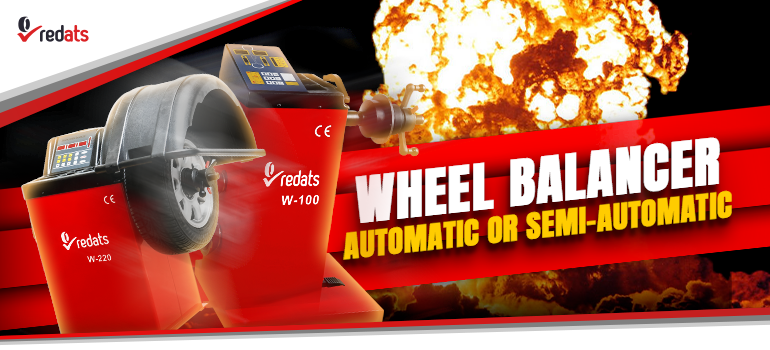
Wheel balancers – automatic or semi-automatic?
Aside from the tyre changer, the wheel balancer is one of the most important equipment for a tyre service. Carefully chosen, it provides the right working comfort with any wheel. While on the lookout for the perfect wheel balancer, you surely got the doubt as to whether get an automatic or semi-automatic one. What are the differences? Would it really make sense to pay more for an automatic balancer? Let’s talk about it!
What wheel balancer should you choose?
While on the lookout for the perfect wheel balancer, look at the following parameters:
- rim diameter
- rim width
- wheel weight that the balancer deals with
If you are dealing with passenger cars mainly, getting a balancer with rim diameter width 20” could be a good idea. Regarding the rim diameter, the perfect value is around 24”. Getting a balancer with parameters like that would let you work with most passenger car wheels.
Automatic and semi-automatic wheel balancers – differences
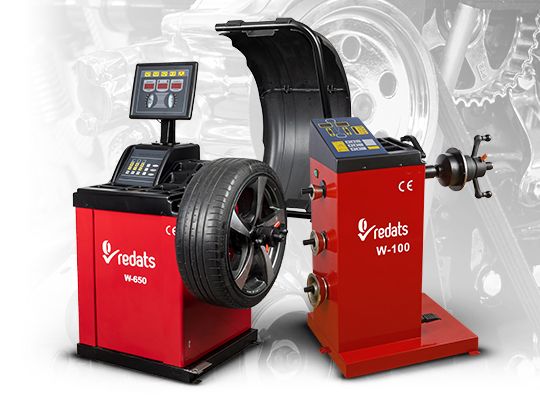
What is the difference between an automatic and semi-automatic balancer? First thing – it’s all about entering wheel parameters. In the semi-automatic version, you have to enter all the information manually. This pertains to the distance, diameter and radius. In case of the automatic wheel balancer, the parameters are read by the machine. This makes the work go much faster – you don’t need to worry about entering the data incorrectly.
Wheel balancers – what parameters?
Automatic wheel balancers can have the following functions:
- rim runout measure
- LED pointer
- voice synthesizer
- hands-free system
- program “hidden weight”
- S-Drive
- weight use statistics
- operator profiles
What are these options for? See below.
Rim runout
There are wheel balancers that come with the rim runout function. This allows for checking if a wheel suffers from the radial runout. How does it work? We’d describe it using the example of REDATS W-770 – one of our top balancers.
- You choose the program.
- You mount the roller (on the bushing).
- You put the roller against the internal part of the rim.
The wheel starts to spin – when it is done, there comes a sound signal. The display shows a graph referring to every measuring point of the wheel. Our balancer shows the measurements according to the rim location (for instance, on the hour “6” or “12”). This lets the operator see the following values:
- rim runout
- possible rim damages
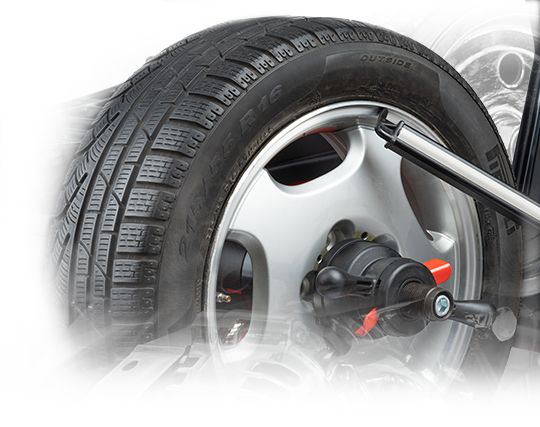
What is that for? Thanks to this function you can check whether a rim needs straightening.
LED pointer – what is that for?
The laser pointer is there for showing the operator the perfect place for weight mounting. Located on the side wall of the balancer, it activates whenever the wheel stops – so it shows the perfect place for knocking or adhering the weight at.
Voice synthesizer
This may seem like a minute detail, not essential for work, but if you tried it, you know it makes the work much easier. The voice from the synthesizer just tells the operator what to do – like, use a certain weight.
Hands-free system
This allows for working with any wheel, without having to push any buttons. How does that work? Well, take a look at how it works in our REDATS W-770:
- Reading the wheel parameters using the arm.
- Closing the cover.
- The wheel stops in the place for mounting the left weight.
- You can knock-on/adhere the weight.
- You can push the wheel a bit.
- The wheel spins itself.
- You can knock-on/adhere the other weight.
- You can take the wheel off.
Easy, right?
Hidden weight program
If you often work with larger ALU rims, you certainly know how challenging it is to hide the weight behind the spokes. That’s why we equip our balancers with the SPLIT function. It divides the weight into two smaller ones, so it is easier to hide it behind the spokes. In case of larger rims, where the weight makes the rim look uglier, this is really important.
Wheel balancers – S-Drive function
What’s this function for? It allows for automatic wheel spin to the imbalanced spot. All it takes is just setting the spin for the “6” or “12” position. Then, push the button and the wheel balancer spins the wheel itself.
Weight use statistics
This is a really useful function that lets you determine which wheel weights are more popular at your tyre service. While choosing a wheel balancer consider getting one that comes with a weight counter.
Obviously, having worked for so many years at a tyre service, you surely know which weight are the most in-demand. However, getting data like that would let you get even more precise information.
Wheel balancers – how to choose?
Keep in mind the following rules:
semi-automatic wheel balancers
- perfect as additional equipment for tyre bay during season,
- perfect for businesses that deal with tyre changing on a rare basis (like car services).
Automatic wheel balancers
- perfect as the main balancer for tyre service
- provide a quicker and more comfortable work